
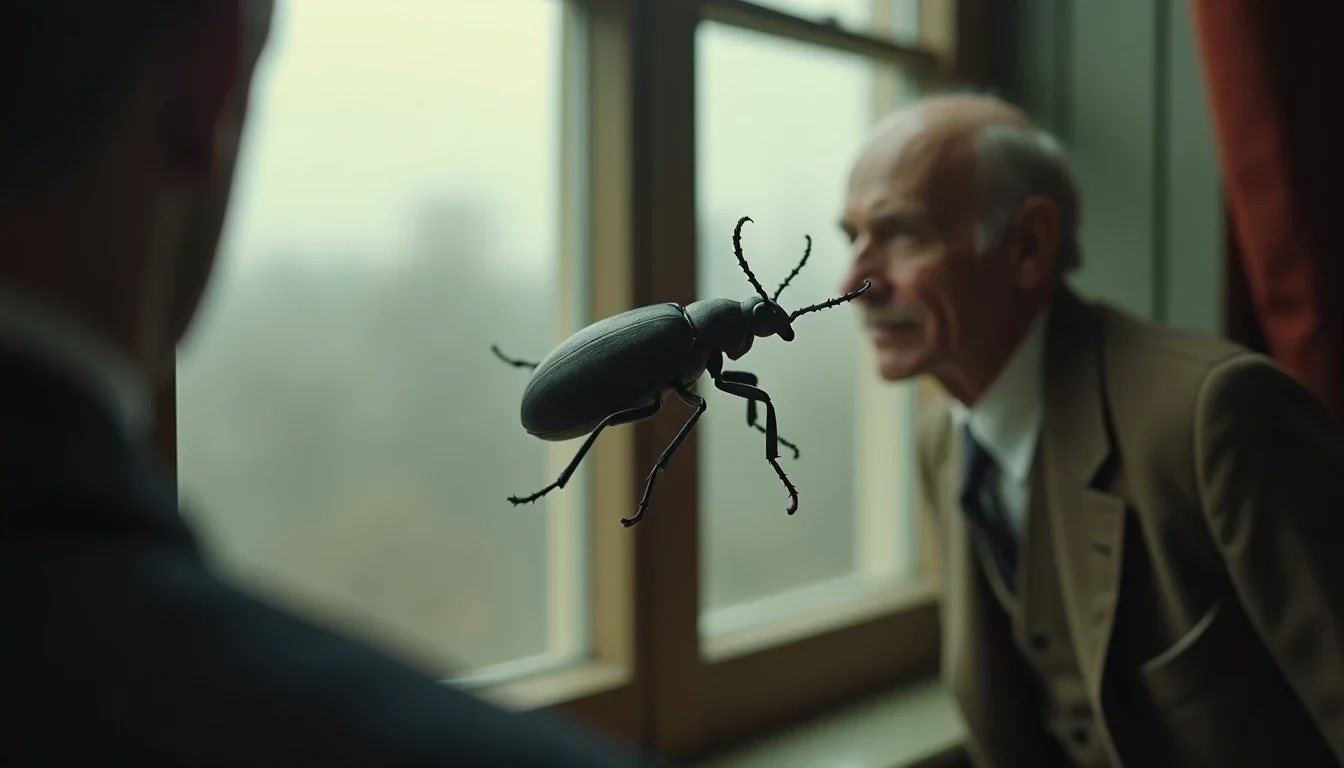
A beetle flew through Carl Jung’s consulting window in 1930 while a patient described a dream about a golden scarab. The insect was not golden, but it was a scarabaeid beetle, rare enough for Switzerland, and it arrived as the dream reached its climax. Jung called it synchronicity, an idea that has divided scientists and philosophers ever since.
What Synchronicity Actually Claims
Jung published his formal argument in Synchronicity: An Acausal Connecting Principle in 1952. The theory holds that some events connect through shared meaning rather than through cause and effect. A psychological state and an external event can align so precisely that probability alone seems an insufficient explanation. The dream did not summon the beetle, nor did the beetle trigger the dream. Something else, Jung proposed, knitted them together.
This “something else” drew on his broader psychology. Jung had already developed the concepts of the collective unconscious, archetypes, and psychological types through decades of clinical work across philosophy, mythology, and religious studies. He suggested that archetypes, those inherited patterns shared across humanity, could operate at the boundary between mind and matter. He termed this borderline quality “psychoid.” The scarab beetle carried weight because it activated an ancient symbol of rebirth, matching the patient’s psychological moment exactly when she needed to break free from a rationalistic deadlock.
Jung and the physicist Wolfgang Pauli pushed further. They explored the unus mundus, a unified ground from which both psyche and physical reality might spring. If mind and matter shared a common origin, their occasional mirroring became less miraculous.
The Scientific Rejection
Mainstream empirical science has never accepted this framework. Objections are specific and repeated across multiple disciplines.
The core problem is falsifiability. A synchronicity that fails to occur can always be explained away: the meaning was not strong enough, the observer was not properly attuned, the conditions were wrong. This immunises the theory against refutation, which places it outside Karl Popper’s standard for scientific claims. Critics argue that synchronicity cannot be tested without the possibility of being proven wrong.
Conventional statistics offers a simpler explanation. Given billions of daily events, staggeringly improbable alignments become mathematically certain. The human mind then selects the striking matches and forgets the misses, a pattern well documented as confirmation bias. Psychologists have a name for the broader tendency: apophenia, the perception of patterns in random noise. What feels like a message from the universe may be the universe’s background static, accidentally shaped into a voice by a meaning-hungry brain.
The subjectivity of “meaning” compounds the difficulty. One person’s profound sign is another’s shrug. Synchronicity resists quantification without an objective measure of significance, and quantification remains the entry fee for most scientific discourse.
Where the Theory Still Lives
Despite these objections, synchronicity retains defenders in fields comfortable with non-local connections and observer effects. Quantum mechanics has produced phenomena that classical causality struggles to accommodate. Entangled particles influence each other instantaneously across any distance, with no detectable signal passing between them. The parallel is not exact, but it has kept Jung’s framework alive in theoretical physics discussions about whether reality at its deepest level might be interconnected in ways that defy linear explanation.
Complex systems theory offers another foothold. Emergent properties, where large-scale patterns arise from countless local interactions without central direction, suggest that causation in the traditional sense may be too crude a tool for certain kinds of order. The brain itself, filtering an overwhelming sensory torrent into workable experience, already operates through pattern recognition run slightly hot. Synchronicity might represent that system catching genuine structure at scales science has not yet mapped, or it might represent the same system misfiring prettily. The debate has no scheduled resolution.
Why the Argument Persists
The scarab beetle has become an emblem for the larger dispute. Jung’s patient broke through her intellectual resistance that day and made progress in analysis. The factual outcome is separate from the theoretical explanation, but the two have become entangled in the literature, each side using the case to illustrate its point.
Synchronicity will not be settled by more scarabs. It sits at a methodological boundary, asking whether meaning can be a genuine property of events or only a projection onto them. Science proceeds by stripping meaning from nature to reveal mechanism. Jung suspected that this stripping, while powerful, might also blind us to a dimension where significance operates as its own connecting principle. The disagreement is not about whether strange coincidences happen. It is about whether strangeness itself can be a datum, or whether the word “strange” merely marks the limits of a particular way of looking.